
Rule Set
IMPORTANT: Participation in the cutting tournaments represents a potential risk to participants/staff/spectators, to include serious injury or death, as well as to equipment. Participants in the cutting tournaments are knowingly choosing to accept this risk of their own volition and understand that the event organizers and staff as well as the tournament organizers/staff are not responsible for any injury or damage to equipment that comes from actions of the participant. Participants also accept and acknowledge that the steps taken by the tournament staff to prevent those injures are satisfactory and sufficient. Participants agree to hold Lake Edge Open and the tournament staff blameless and free from any and all liability. Please read the safety waiver carefully and fully. A competitor will not be allowed to complete without a signed safety waiver.
Disqualifications: This document will serve as the ONLY warning for disqualifications based upon unsafe actions. If a competitor conducts themselves in an unsafe manner placing themselves, staff, fellow competitors or spectators in danger they will be disqualified from the cutting events without further warning. Safety goes beyond the written rules of the event and requires common sense and respect for the dangers inherent in cutting with a sharpened sword.
Examples (not all inclusive): Horseplay while holding a sharp sword (to include acting as cutting towards another person), losing control of the sword where another person is placed in danger (“throwing” the sword).
Safety: Competitors are required to observe the following (including but not limited to) safety guidelines at all times. Violations of these guidelines may result in a warning or immediate dismissal from the cutting tournaments at the sole discretion of the tournament staff:
1. Always follow the instructions of the tournament staff without hesitation or argument.
2. Be aware of your surroundings at all times.
3. Do not swing your sword if there are people near you, especially directly behind you.
4. Ensure your hands and hilt are dry before cutting.
5. Competitors are not to handle the targets during the tournament. Staff will handle all set up, adjustment and removal of target and/or target pieces.
6. Do not cut before being advised by tournament staff indicates they are ready for the competitor to begin.
7. Always approach the target from the specified direction.
8. Always remember that a sharp sword is a deadly weapon that is capable of injuring, maiming or killing another person.
Equipment: Competitors swords should be of high quality, from a recognized maker/manufacturer, and be in good working order. For longsword and arming sword competition, swords must fall within the Oakeshott typology, as well as fall within the historical norms of the sword type, and/or be a replica of a historical medieval sword. For messer/falchion, swords must fall within the Elmslie Typology, as well as fall within the historical norms of the sword type, and/or be a replica of a historical messer/falchion. Tournament staff and judges will have ultimate say on what is acceptable for use in the cutting tournament. Loaner swords will be available for each event.
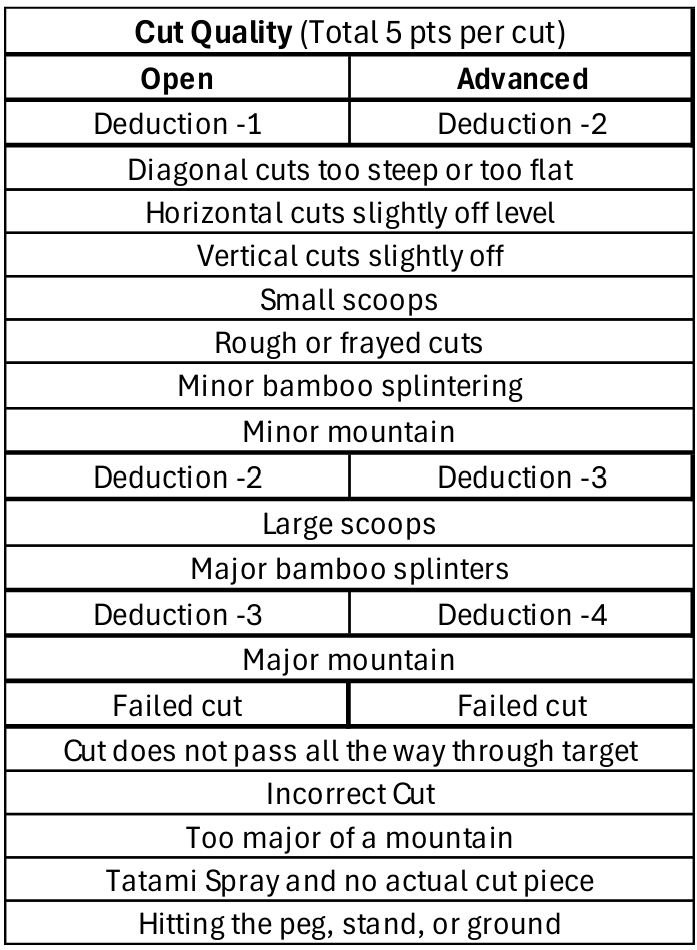
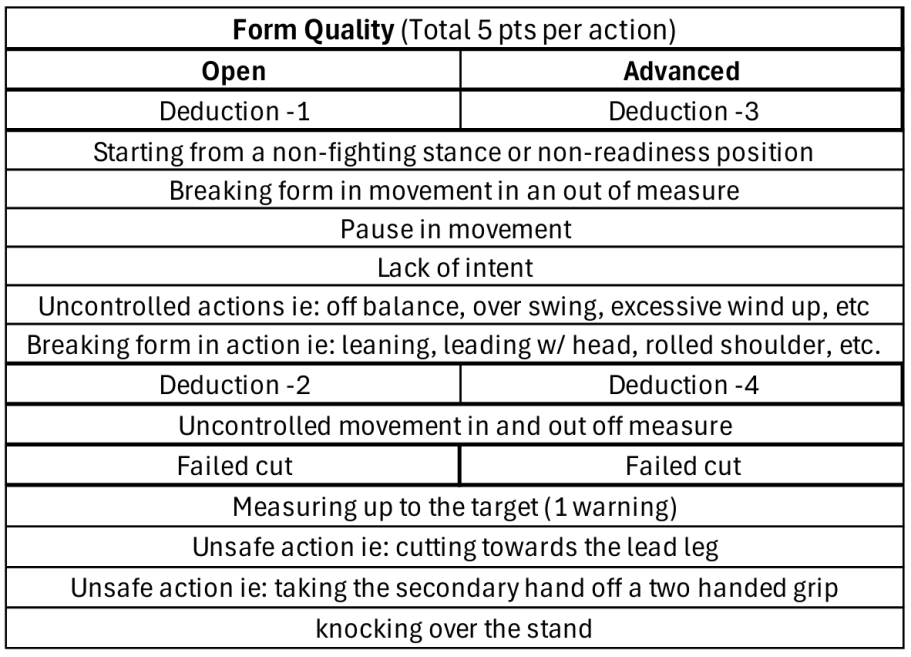
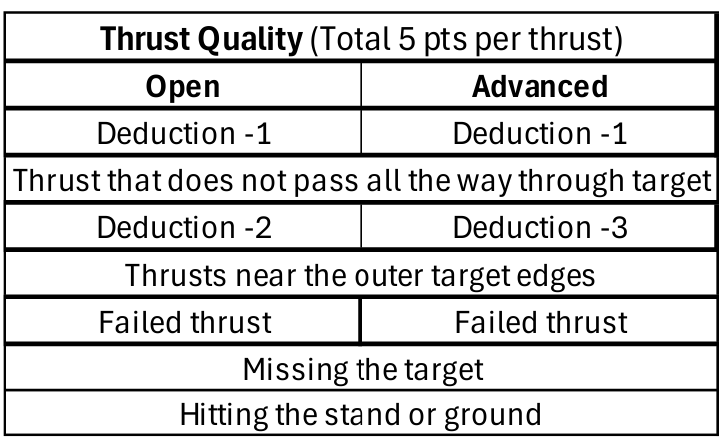
Scoring: See the deduction table below for general scoring, as well as each feat below. In general, individual cuts and thrusts are worth up to 10 points each, split between cut/thrust quality and form quality. For a more detailed breakdown of deductions, please see appendix B. Note: letting go of, dropping, or losing the sword during a feat will result in a disqualification from the event.
Judges: For this event there are two primary judges. The judges are responsible for observing the cut/thrust quality, and form quality, and assigning deductions to the score as appropriate. There will be a third judge who will act as a spotter for thrust feats.
General Scoring Deductions (See Appendix B for Judging criteria)
Appendix A – Cut and Thrust Definitions
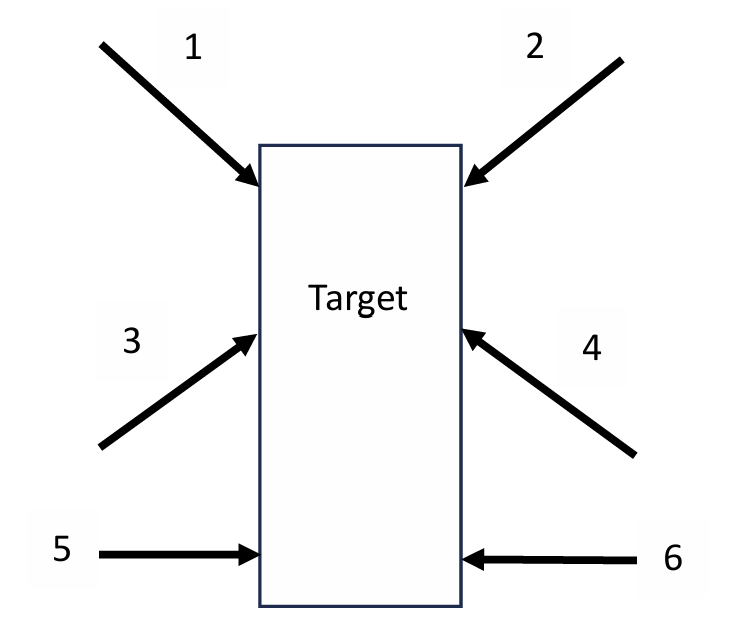
Basic Cuts -
Thrusts -
Short thrust – thrust with no or minimal step performed from in measure
Long thrust – thrust requiring a large passing step to get into measure
Appendix B - Judging Criteria
Deductions applied to round score will either be the highest major deduction, or the sum of minor deductions, whichever is highest. Minor deductions from each category may be culminative at the judge’s discretion, however, deductions may reduce the score to 1, not below, if a successful cut or thrust is completed. (Minimum score of 2 total for successful cut. 1 for cut/thrust quality, 1 for form quality)
Cut Quality
1) Cut completeness
- Any cut that does not pass all the way through the target is considered a failed cut
2) Cut Angle
- For diagonal descending or ascending cuts, cut should be performed at approximately 45 degrees. Cuts too steep or too flat will receive -1 points for open cutters, and -2 for advanced cutters. If a cut is determined to be horizontal when it should be a diagonal, it will be considered a failed cut.
- For horizontal cuts, cuts should be performed as approximately horizontal. Cuts slightly off horizontal will receive -1 points for open cutters, and -2 points for advanced cutters. Cuts determined to be not horizontal will be considered a failed cut.
- For Vertical cuts, cuts should be approximated vertical. Cuts slightly off vertical will receive -1 points for open cutters, and -2 points for advanced cutters. Cuts determined to be not vertical will be considered a failed cut.
3) Cut linearity and smoothness
- Any cut performed should be linear. Small scoops in the cut will receive -1 points for open cutters, and -2 points for advanced cutters. Large scoops will receive -2 points for open cutters and -3 points for advanced cutters.
- Rough or frayed cuts will receive -1 points for open cutters, and -2 points for advanced cutters.
- Minor splintered bamboo cuts will -1 points for open cutters, and -2 points for advanced cutters.
- Major splintered bamboo cut will be -2 points for open cutters, and -3 points for advanced cutters.
4) Intersecting cuts
- Any cut that has a minor intersect with the prior cut (mountain) will receive 1 points for open cutters, and -2 points for advanced cutters.
- Any cut that has a major intersect with the prior cut (mountain) will receive 3 points for open cutters, and -4 points for advanced cutters.
- A cut may be deemed a failed cut if the intersection is considered too major
5) Thin cuts
- Any cut that does not produce a solid piece of target that separates from the main target, may be deemed a failed cut (tatami spray)
6) Cutting the Peg
Any cut that cuts the peg or stand may be deemed a failed cut.
Thrust Quality
1) Thrust completeness
- Any thrust that hits the target with sufficient force and successfully retracts will be considered a successful thrust. Thrusts do not have to pass through the target entirely to earn points.
- Thrusts that miss the target will be deemed failed thrusts.
- Thrusts that hit the stand will be deemed failed thrusts
- Thrusts that knock over the stand will be considered failed thrusts
2) Thrusting depths
- Full points will be available for thrusts that clearly pass through the target, visible by the table judges. (we do not want to slow down feats or stop participants to check tip depth)
- Thrusts that do not pass all the way through the target will receive -1 point
3) Thrusting accuracy
- Thrusts that hit roughly center will have full points available
- Thrusts that hit near the outer edges of the target will receive -2 points
Form Quality
1) Out of measure stance and readiness
- When signaled to start an action, unless otherwise directed by the judges to start in measure, competitors will assume an appropriate sparring/fighting stance and show readiness out of measure to enter an action.
- Competitors starting an action from a non-fighting stance or non-readiness position will receive a -1 for open cutters, and a -3 for advanced cutters, unless specified by the judges to do so.
- Measuring up to the target will receive a warning first, then failed cut on the second infraction.
2) Entering into an action (cut or thrust)
- Competitors are to enter into an action in a controlled manner with intent to cut (as if the target was a sparring partner and it was a sparring situation). Note, this does not necessarily mean “fast”. Competitors who break form and walk to target will receive a -1 for open cutters and -3 for advanced cutters.
- Competitors who enter into an action in an uncontrolled manner will receive a -2 for open cutters and -4 for advanced cutters.
3) Performing the action (cut or thrust)
- Competitors performing an unsafe action (i.e.: cutting towards the lead leg in an unsafe manner, taking the secondary hand off a two-handed grip, etc.) will result in a failed cut.
- Competitors shall not pause movement prior to performing an action. Pause in movement shall receive a -1 for open cutters and -3 for advanced cutters
- Competitors shall perform the action in a controlled motion with intent (as if the target was a sparring partner and it was a sparring situation). Note, this does not necessarily mean “fast”. Uncontrolled actions will be a -1 for open cutters and -3 for Advanced cutters. This includes: off balance, over swinging, excessive winding up, etc.
- Competitors shall perform the action in an appropriate stance. Breaking form during the action will receive a -1 for open cutters and -3 for advanced cutters. This includes: leaning, leading with the head, exposing the shoulder after the cut, etc.
- If a competitor’s action knocks the stand over, it will be deemed a failed action
- If a competitor’s action hits the stand or ground, it will be considered a failed action
4) Returning to out of measure
- After the action, unless otherwise directed by the judges (some feats will require multiple actions), competitors will move back out of measure while maintaining appropriate sparring/fighting stance and show readiness out of measure to complete the round.
- Competitors breaking form while moving out of measure will receive a -1 for open cutters, and a -3 for advanced cutters.